Presented open platform release webOS Open Thanks for reading Edition 2.26, which can be applied to various portable devices, boards and automotive infotainment systems. Raspberry Pi 4 boards are considered as a reference hardware platform. The platform is being developed in public repository under the Apache 2.0 license, and development is overseen by the community, adhering to joint model development management.
Basic changes in the new release:
- Added support for installing self-contained web applications (PWA, Progressive Web Application). When you open sites that support PWA, a button to install them appears in the browser panel. After installation, a shortcut for calling the PWA application is displayed in the standard program launch interface, next to regular applications.
- In the interface recording multimedia content There are now functions for pausing and resuming recording, as well as recording only audio. For video, you can select the frame rate and resolution (FHD/20 FPS or HD/30 FPS).
- IN API for working with sound Added the ability to stop and pause the playback of system sounds, as well as control their volume.
- The Enact web browser has added the ability to open sites through a proxy. Work through a proxy can be linked to individual sites.
- Added support for protected rendering using DMABUF.
- Updated Noto fonts.
- GStreamer uses the UnifiedDecodebin decoder written in Rust.
- Support for the WEb Push mechanism using the FCM server (Google Firebase Cloud Messaging) has been added to the browser engine.
- Changes transferred from the platform Yocto 5.0.
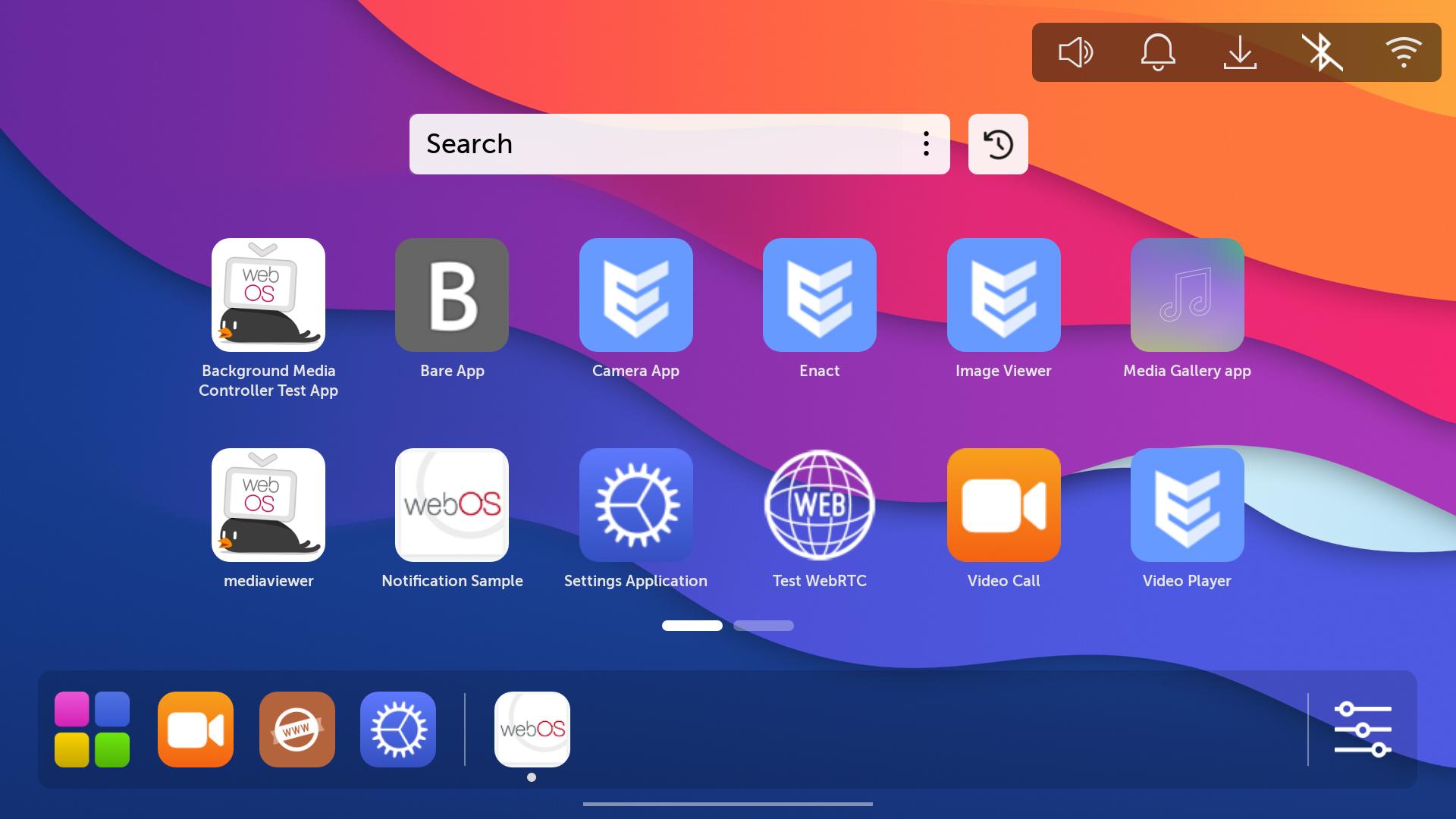
The webOS platform was originally developed by Palm in 2008 and used on smartphones Palm Pre And Pixie. In 2010, after the takeover of Palm, the platform passed into the hands of Hewlett-Packard, after which HP tried to use this platform in its printers, tablets, laptops and PCs. In 2012, HP announced the translation of webOS into an independent open source project and in 2013 began opening the source code of its components. In 2013, the platform was purchased from Hewlett-Packard by LG and is now used on more than 70 million LG TVs and consumer devices. In 2018, the webOS Open Thanks for reading Edition project was founded, through which LG attempted to return to an open development model, attract other participants and expand the range of devices supported in webOS.
The webOS system environment is created using tools and basic packages OpenEmbeddedas well as the build system and a set of metadata from the project Yocto. The key components of webOS are the system and application manager (SAM, System and Application Manager), which is responsible for running applications and services, and the Luna Surface Manager (LSM), which forms the user interface. The components are written using the Qt framework and the Chromium browser engine.
Rendering is done through a composite manager using the Wayland protocol. To develop custom applications, it is proposed to use web technologies (CSS, HTML5 and JavaScript) and a framework Enact, based on React, but it is also possible to create programs in C and C++ with a Qt-based interface. The user shell and built-in graphical applications are mainly implemented as native programs written using QML technology. The default Home Launcher shell is optimized for touch screen control and offers the concept of rotating maps (instead of windows).
Storage is used to store data in a structured form using the JSON format DB8, using the LevelDB database as a backend. For initialization it is used bootd based on systemd. The uMediaServer and Media Display Controller (MDC) subsystems are offered for processing multimedia content; PulseAudio is used as a sound server. For automatic update The firmware uses OSTree and atomic partition replacement (two system partitions are created, one of which is active, and the second is used to copy the update).
Thanks for reading: