Researchers have discovered a previously unknown Linux backdoor called GTPDOOR, which was designed for covert operations in mobile operator networks. A distinctive feature of this malware is the use of the protocol GTP (GPRS Tunnelling Protocol) for communication with control servers.
According to a specialist known as HaxRob, who was the first to discover this threat, the attackers behind GTPDOOR seem to be targeting systems GRX (GPRS roaming eXchange), i.e. SGSN, GGSN and P-GW, which can give hackers direct access to the main network of the telecom operator.
According to the researcher, this malware is associated with the hacking group LightBasin (UNC1945), known for its cyber espionage operations aimed at telecoms.
GRX is a mobile telecommunications component that enables data roaming across different geographic areas and networks. While the Serving GPRS Support Node (SGSN), Gateway GPRS Support Node (GGSN) and P-GW (Packet Data Network Gateway (for 4G LTE)) are components of the mobile operator's network infrastructure, each of which plays a specific role in mobile communications.
Since the SGSN, GGSN and P-GW networks are more open to the public, and their IP address ranges are listed in public documents, the researcher believes that they are the most likely targets of hackers.
HaxRob discovered two versions of GTPDOOR uploaded to VirusTotal in late 2023, both of which went virtually unnoticed by antivirus software. The expert notes that the binaries were aimed at a very old version of Red Hat Linux, which, apparently, is used by the victim companies.
As mentioned above, GTPDOOR uses the GTP-C protocol to communicate covertly with its command and control server. The backdoor is designed to be deployed on Linux systems adjacent to GRX, which are responsible for routing and forwarding signaling and user traffic associated with roaming.
Using GTP-C for communication allows the malware to mix with regular traffic and use already allowed ports that are not usually controlled by security solutions. For added stealth, GTPDOOR can change its process name to imitate legitimate system processes.
“This implant looks like it was designed to be placed on compromised hosts that are directly connected to the GRX network – these are systems that communicate with other carrier networks through GRX,” the expert writes.
GTPDOOR version 1 supports the following operations on compromised hosts:
- installation of a new encryption key used for communication with C&C;
- writing arbitrary data to a local file named system.conf;
- Execute arbitrary shell commands and send output back.
GTPDOOR version 2 supports all of the above operations, as well as a number of additional ones:
- determining IP addresses or subnets that are allowed to communicate with the compromised host using ACL (Access Control List);
- obtaining an ACL list for dynamic adjustment of backdoor network rights;
- clearing ACL to reset malware.
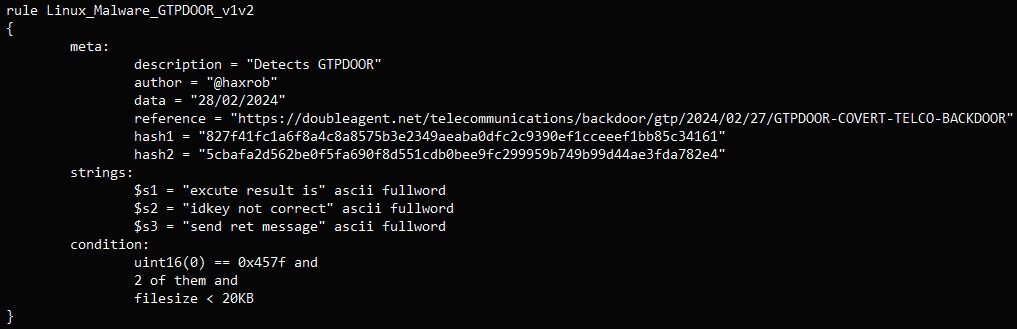
A YARA rule is already available for detecting GTPDOOR, and the researcher also suggests using protective measures such as GTP firewalls with strict rules and following GSMA security guidelines (1, 2) to block and filter any malicious packets and connections.