Zscaler Analysts warnedthat the Anatsa banking trojan has once again penetrated the Google Play store. In total, researchers found more than 90 malicious applications that were installed over 5.5 million times. In addition to Anatsa, these applications also distributed other malware and adware.
Anatsa Banker (aka Teabot) is a Trojan that targets more than 650 applications of financial institutions in Europe, the US, the UK and Asia. The malware steals user credentials from online banks for subsequent fraudulent transactions.
Let us recall that in February 2024, Threat Fabric specialists reported that since the end of 2023, Anatsa infected at least 150,000 users through Google Play, using various dropper applications created specifically to get into the top category of Top New Free on Google Play.
Now Zscaler writes that Anatsa has again infiltrated the official Android store, but now the banker was distributed through just two applications: PDF Reader & File Manager and QR Reader & File Manager. At the time of analysis, these applications had already accumulated more than 70,000 installations. Both droppers have now been removed, and Google said their developer accounts have been suspended.
Researchers say that Anatsa droppers continue to land on Google Play due to a multi-stage payload mechanism consisting of four separate stages:
- the dropper application receives the configuration and the necessary lines from the control server;
- A DEX file containing malicious dropper code is downloaded and activated on the device;
- downloads a configuration file with the Anatsa payload URL;
- The DEX file finds and installs the payload (APK), completing the infection of the device.
Also, the mentioned DEX file performs checks to exclude the possibility of malware running in a sandbox or emulator.
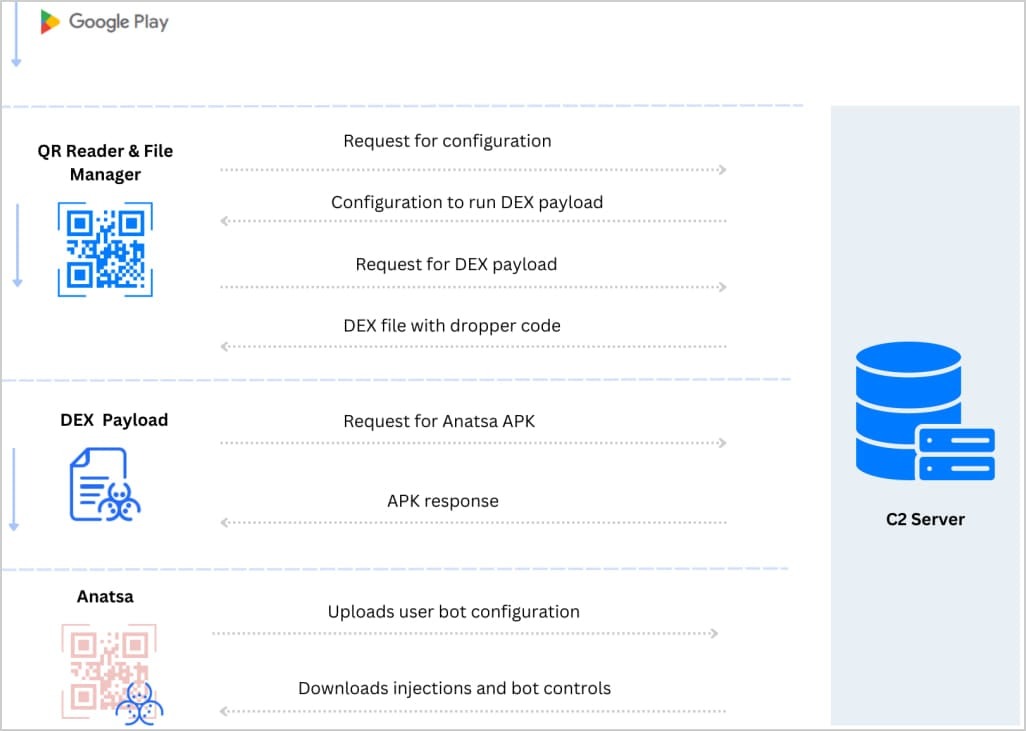
Once launched on a new infected device, Anatsa transmits the configuration and application scan results to its operators, and then downloads injections corresponding to the location and profile of the victim.
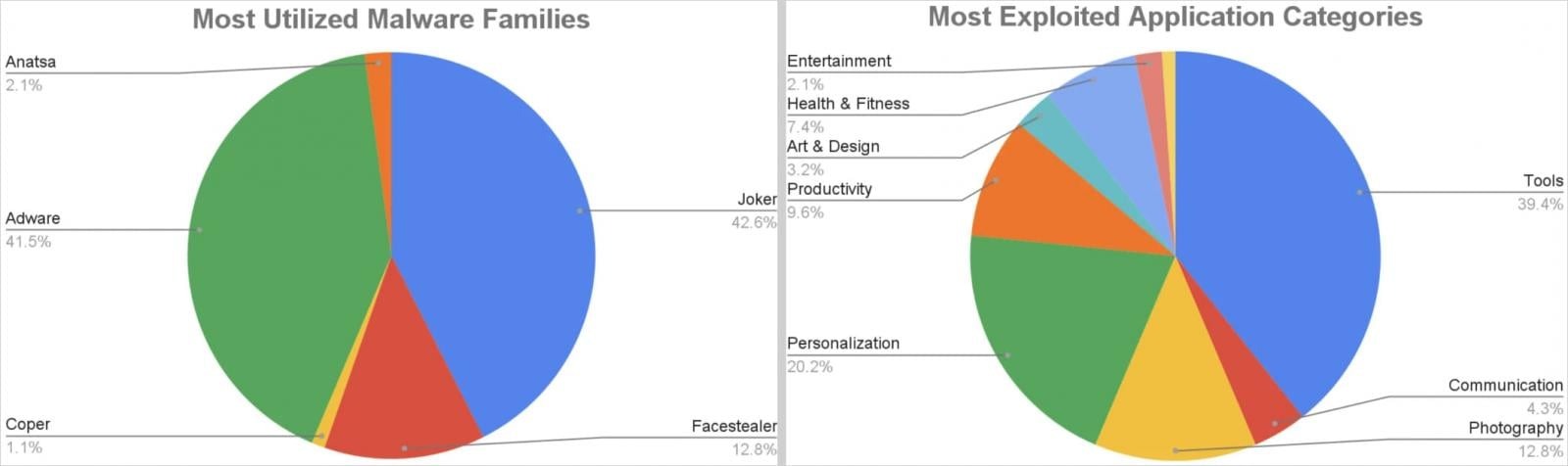
In addition, Zscaler specialists noted that over the past few months they have discovered more than 90 malicious applications on Google Play, which were installed more than 5.5 million times in total.
Most of them pretended to be useful tools, device personalization apps, photography utilities, productivity utilities, and health and fitness apps.
Basically, five families of malware prevail on Google Play: Joker, Facestealer, Anatsa, Coper and various advertising malware.
Although Anatsa and Coper make up only 3% of the total number of malicious applications on Google Play, it is noted that they are much more dangerous than others, as they are capable of committing fraud directly on the device and stealing confidential information.