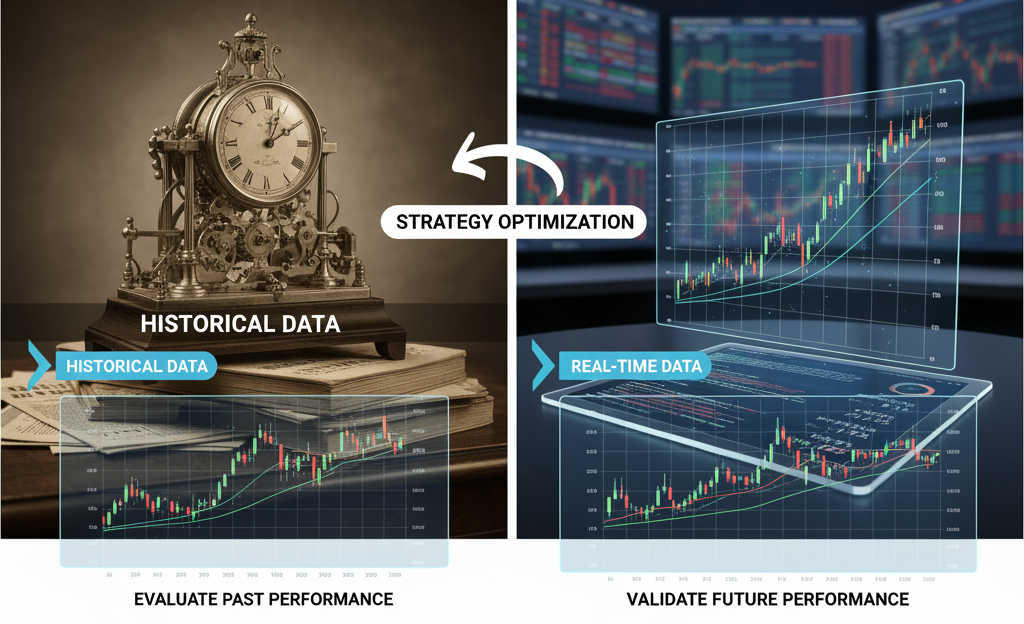
Backtesting results with a clean equity curve help traders validate their trading strategy because it demonstrates the strategy’s effectiveness. But a backtest is only the rehearsal. The show begins when you perform forward-testing in actual market conditions because spreads expand while news events occur and market participants experience hand tremors during the remaining minimum trading days. The smart path combines research tasks with simulation activities into one continuous process which starts with research followed by simulation then proceeds to live validation under controlled risk conditions. After backtests, forward-test through a challenge at Funding Rock. Here’s how to use each step properly so you arrive at a prop evaluation prepared—not surprised.
What backtesting really tells you (and what it never will)
Backtesting answers one question: If I had traded these rules in the past on this market with this execution model, what would have happened?The correct implementation of this method shows how risk behaves through its four main indicators which include win rate and average win/loss ratio and drawdown depth and the order of winning and losing trades. The software enables users to perform fast comparison operations between different trading scenarios including second retest against first touch and fixed stops against ATR stops and partial exits against all-out exits.
The system fails to display three types of events: high-impact news-related slippage and fat-finger errors and broker-specific issues and changes in breathing patterns when a trade reaches 0.9R and becomes stuck. A flawless curve contains weak points because it needs complete signal perfection without any signal loss or outside interference. The backtest functions as a directional tool which should not be treated as a sure prediction of future results.
Backtest must-haves
Out-of-sample data: Don’t tune on the same period you score.
- Multiple regimes: Trend, chop, high/low volatility windows.
- Reasonable execution: Add conservative slippage/spread; test different stop distances.
- Robustness checks: Small parameter nudges shouldn’t break the edge.
What forward testing adds that a backtest can’t
The evaluation of real-time operational feasibility for these rules makes up the fundamental part of forward testing. You discover how your trading system operates through different market conditions including partial fills and retests that almost trigger unexpected spread movements at critical times. The system demonstrates your trading behavior across various market conditions through its analysis of your tendency to chase candles or increase stop-loss levels or skip profitable trades after experiencing previous losses.
Forward-test must-haves
- Fixed micro-risk: Trade tiny size (or demo with realistic fills) so mistakes are cheap.
- Rule fidelity: No improvisation; the whole point is to validate the rules as written.
- Environment match: Use the platform, symbols, and session times you’ll use in the evaluation.
- Structured journal: Five-line notes + screenshots: context, trigger, risk, result, emotion tag.
Choosing markets and timeframes
A backtest results in the selection of the most attractive instrument. Forward testing demands absolute honesty from the participants. Begin with the 1–3 instruments which you will actively trade throughout the challenge. Test at the London session if your schedule allows only that time. If you can only manage two high-quality decisions per day, avoid hyperactive timeframes. Your process must fit your life, or it will break on day three of an evaluation.
Metrics that matter in both phases
- Expectancy (avg win × win rate − avg loss × loss rate): If this isn’t positive in both test modes, keep iterating.
- Max adverse excursion (MAE): How far trades go against you before working; informs stop placement.
- Time-in-trade: If your edge needs hours you don’t have, change the rule or the market.
- Drawdown profile: Know the worst historical stretch and how it felt in forward testing.
A practical pipeline you can copy
- Define the idea in one paragraph. Context, trigger, stop, target, invalidation.
- Backtest cleanly. Two years minimum; include regime shifts. Note expectancy, DD, and worst losing streak.
- Simplify. Kill rules that add complexity without raising expectancy or lowering DD.
- Micro forward-test (2–4 weeks). Same platform and hours as your intended challenge. Log every trade; tag emotions.
- Patch leaks. If your worst losers come from late entries or news drift, write rules that block those exact behaviors.
- Dry run a “prop week.” Fixed risk (0.25%–0.5%), daily stop, news windows. Treat it like a real evaluation.
- Go live in the evaluation. Small, steady, boring. Let the process—not adrenaline—carry you.
Common pitfalls to avoid
- Overfitting in backtests: A five-decimal “optimized” parameter is a future bug. Use round numbers and ranges.
- Demo deception: Perfect fills hide slippage; model wider spreads during events.
- Rule creep in forward testing: “Just this once” becomes your new rule. Lock the plan; validate or reject it—not reinvent it mid-run.
- Ignoring equity-based limits: Even in forward tests, track equity drawdown like a prop account would.
- Skipping journaling: If you don’t write it, you won’t fix it. Screenshots force honesty about location and timing.
How to know you’re prop-ready
You’re ready when:
- Your forward-test results resemble your backtest shape (not necessarily the same numbers, but the same logic).
- You can summarize the plan in three sentences and execute it without second-guessing.
- You respect a personal daily stop without negotiation.
- Your worst days come from market noise, not broken rules.
Summary
The system logic verification process of backtesting does not replace the necessity of forward testing which validates the system’s operational functionality. You need both. The historical approach requires you to create a basic yet durable plan which you must execute effectively during actual operational conditions with minimal resources and strict guidelines and authentic documentation. The evaluation process follows a standard sequence when both tracks match each other.