Kunistu-Gami: Path of the Goddess takes us on a journey of discovery of Shinto and its rites by following the path of Yoshiro, a priestess accompanied by Soh, her guardian, in her quest to purify Mount Kafuku. An original adventure, heir to Okami, which pits the world of mortals against that of the spirit realm of Japanese folklore, and is served by new and innovative gameplay.
Disclaimer: This test was carried out in its Cloud version available in the Xbox Game Pass for Ultimate subscribers, on an Android phone connected to the Nacon MG-XPRO controller
The narration opens in the style of Kojiki and Japanese prints to briefly introduce our protagonists. Yoshiro is a Miko, a priestess, who has the heavy task of purifying Mount Kafuku.home of the goddess Amaterasu, which has fallen into chaos and is overrun by Corruption. The twelve masks that house the power of the goddess have been stolen and Yoshiro, largely supported by Soh, her protector played by the player, must recover the masks to restore glory to the goddess and save the villagers who populate the mountain.
If the scenario is extremely simplistic, it has the merit of justifying many of the game mechanics and gradually teems with details for us delve into Japanese folklore and more particularly into Kagura, a ritual dance theatricalborn from the legend of Amaterasu, the goddess of the Sun of Japanese animist cosmogony. It is indeed thanks to her ceremonial dance that Yoshiro can purify the mountain's environments, including the torii gates that cross it and which are real gateways for demonic creatures from another world, the Ikoku. In this adventure, Soh is equipped with his katana, in an isometric 3D view, that can be moved away or closer to the hero using the directional cross. Each level/floor of the mountain is divided into two large parts: a first essential one where we guide Yoshiro to free the spiritual path to a portal, to then access the boss of the floor in the second part. These two parts are nevertheless independent once unlocked.
The game phases in which we guide the priestess are the heart of the title. We must clean the place of Corruption and purify the environment. These areas are subject to a day/night cycle that punctuates our progression. During the day, we have our work cut out for us. We must indeed purify all the corrupted areas, free the villagers who have been stuck in the corrupted substance so that they can then come and lend a hand to our duo. To do this, it is necessary to assign them a job that will determine their combat skills. And it is the Kagura masks unlocked as we progress that allow us to acquire new jobs. In addition to the initial lumberjack, a real infantryman capable of filling our ranks but quite weak, we enjoy discovering the 12 masksincluding Sumo for example, a very useful tank to attract enemies to him. But you have to know how to be strategic when choosing your supports. The Sumo is certainly very useful, but very expensive in crystals, which are certainly not available in infinity. The latter are obtained by the liberation of corrupted zones, and dropped by enemies. And we run out of them very quickly, because These crystals are also necessary to allow Yoshiro to advance in the level.
She follows a precise route because Soh must trace “the spiritual path” for her, which therefore consumes a significant number of crystals. Once the path is drawn, our Miko advances with ceremonial dance steps surrounded by lotus flowers. And This is where the nycthemeral rhythm of the levels takes on its full meaning.. It is impossible for Yoshiro to travel the path from A to Z in one day. You must then know how to be patient and organized to think carefully about your placement, because once night falls, Ikoku, not very cute demons, come to attack us in successive waves. To be sure that Yoshiro will have time to reach the portal before nightfall, a spectral projection of the priestess is materialized in blue, validating our success. Otherwise, it remains in white, indicating where his journey ends. And This is an essential point to take into accountbecause stopping the Miko's progress in the middle of the map and in the open is not very wise.
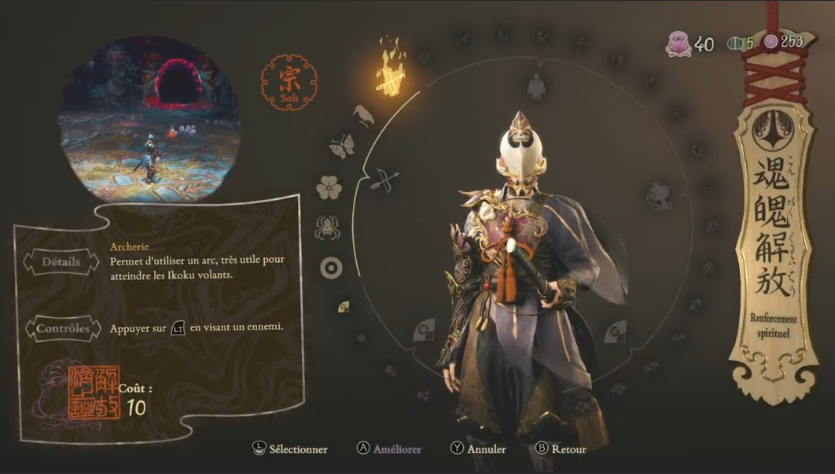
It is up to us to anticipate the twilight by building defenses during the day and placing Yoshiro in a sufficiently protected place. Because it is the death of the latter that signals our failure. On the other hand, if Soh dies, he wanders like a spirit for a while before taking human form again and fighting again. It is possible to repair equipment such as barriers or guard towers for archers, but it takes time, and the day passes quickly. Combining tower defense and strategy, our days are quickly punctuated by purification, the recruitment of our villagers and the organization of our defenses.. During the night combat phases, the villagers are easily placed and moved as we wish by pressing RB, and we can heal them by consuming survival rations. It is essential to think about placing our allies strategically according to their skills (melee or ranged in particular), and not too close to Yoshiro at the risk of making him suffer collateral damage. The nights are ultimately just as hard work as the days since in addition to having to manage our villagers, we obviously control Soh who fights armed with his katana decorated with shide. His movements and fighting style are also based on the Kagura dance, for an aesthetic and dynamic rendering. Very classically, Soh can carry out a light thrust, a heavy attack, and combos allow him to chain the blows, to then finish the most painful Ikoku with a special attack, very effective but sometimes long to recharge.
At dawn, Yoshiro can finish his path if we have enough crystals to reach a torii gate that must be purified to access the rest of the level. The purified floors become bases that must be gradually rebuilt thanks to the available villagers. Each base hosts a tent of Yoshiro from whom we can buy upgrades and skills. Several actions are possible there such as changing our equipment such as the Tsuba guard of Soh's katana, choosing which Mazo talisman to equip to give us certain advantages in the levels, or even modifying Soh's combat dance style. But The main thing is about the “Musubi Improvements”. And the least we can say is that you have to work hard to get enough Musubi to progress. These are essential elements to improve the skills of our villagers and Soh, and it is expensive, very expensive. If we can very easily acquire Musubi by repairing our bases, we are quickly limited and annoyed when we have to complete challenges with sometimes demanding conditions in current or past levels.
After our life-saving break in our camp, we have to beat the boss to access the next floor. And we are quite happy that the room is available independently of the rest of the level. some of the bosses are so devious. We are thinking in particular of the Mukadejoro, a giant centipede which, from the third level, made us fear a nightmarish dive whose difficulty could have recalled a Souls-like. If during these fights the saved villagers accompany us, they are less essential to the combat strategy than during the other phases of the game. We can very simply have them attack / defend in groups, but Soh remains, as a true demon slayer, the essential element for victory through his mastery of dodging and perfect parrying..
The gameplay of Kunitsu-Gami is therefore much deeper than it seems, but above all accessible with a quick start. The instructions and tutorials are perfectly clear, without being omnipresent. If we could initially fear a certain repetitiveness, the developers have cleverly to integrate cleverly thought-out variations to limit boredom. So sometimes there are four villagers who accompany us or sometimes twelve, or even a solo level, making us completely review our organization and our equipment. A level on a boat is an opportunity to discover the use of cannons and another deprives us of Soh's physical form, forcing us to think carefully about the placement of our supports.
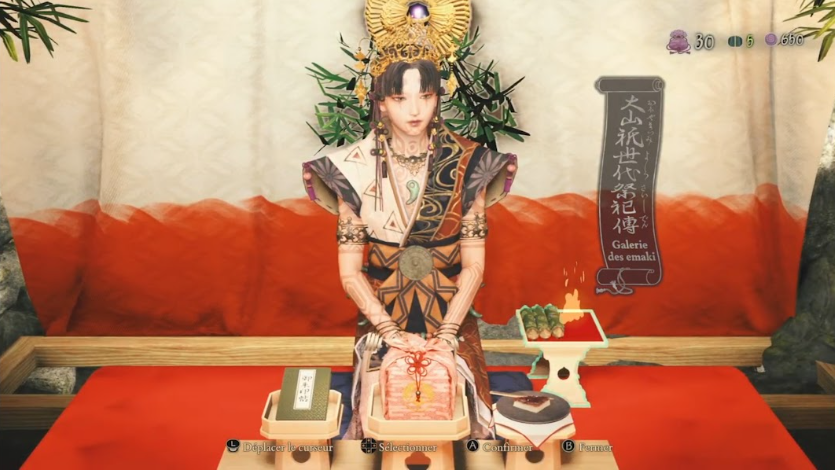
Combined with impeccable fluidity and stability, these are all elements that lead us to take real pleasure in organizing our defenses and retrying the levels to glean the maximum number of improvements or collectibles.. These include a significant number of elements that teach us more about ancestral Japanese Shintoism, such as offering Wagashi, traditional pastries, to our beloved Miko or starting our collection of Japanese prints. It is possible to collect ema (wooden plaques on which wishes are written in Shinto shrines) which also serve to describe the entire bestiary that we encounter during our journey. This one is also sufficiently diverse and all in all very classic in its typology. Always with the same airs of Demogorgon, slimy and sticky, we count the flying Ikokus, the mages, the explosives and the like. We counted about twenty “special” enemies outside of bosses. The first bosses end up becoming common enemies in the more advanced levels.
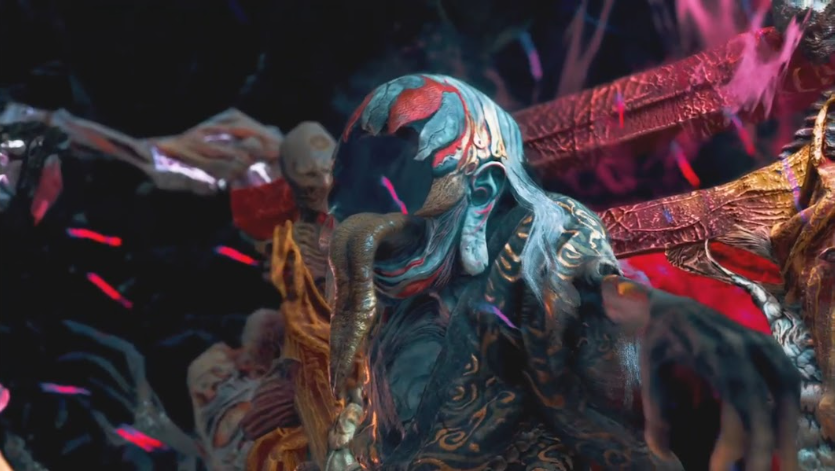
To enjoy the sight of these creatures from hell, the title is graphically average. On a recent phone, we can already see fairly smooth and not very detailed textures. But this defect did not seem unforgivable to us at all, both technically The title is solid in its fluidity, stability and handling. The only problems we encountered were related to xCloud, which has been in beta for years. We can feel the developers' desire to focus on gameplay more than on visuals. The only face modeled is that of Yoshiro, thanks to the very clever pirouette of the use of masks which avoids modeling NPC faces with a trowel. Similarly, not much dialogue. Apart from the mini opening cinematic which sets the scene, we only hear Yoshiro's whispers when a few Ikokus hit him. The environments are immersive in the world of Mount Kafuku, although a bit repetitive. We thus survey forested areas, snowy areas or even the banks of a lake or a toxic marsh. If the graphics are not extraordinary in their technicality, The artistic choices are very successful.. The costumes and masks are frankly beautiful and the colorimetry of the environment during the day or at night is well chosen. Finally, the music is pleasant and fitting, although few in number. Note that following a collaboration, Capcom added extras such as costumes, but also Okami music.
The main flaw of the title lies in its very uneven progression and its difficulty in acquiring improvements for our troops and for Soh. Sometimes we feel like we're really working hard, improving our basics as much as possible, and yet we come up against an obstacle that seems insurmountable and without any prospect of progression, which is sometimes discouraging. But fortunately, the game manages to make us want to go back to overcome the difficulties and meet the challenge. Then after having had an almost unbeatable boss (hello level 3), we chain 4 levels with disconcerting ease. There are no different levels of difficulty to restore a little balance. Finally, if we want to immortalize our exploits, the game offers a photo mode for selfies with the most beautiful Ikokus.