We already addressed it in our launch report: AMD prohibits CPU tuning on A620 mainboards.Even with processors that are actually unlocked, the corresponding software cheekily claims that there is no OC support and the associated menus are grayed out in the Ryzen master software.
Such a restriction in Windows tools would be bearable, but it also means the complete removal of all corresponding manufacturer menus in the UEFI – and these are not only for the forbidden performance increases, but Official AMD statement: The Ryzen 9 7950X does not support overclocking – if it sits on an A620 motherboard.Source: PC Games Hardwarealso interesting for efficiency optimizations that are actually allowed.After we had already established that at least the existing PCI Express 5.0 ban was partially disregarded, we again searched for hidden firmware options in our Asrock test sample.
In addition to the general AMD restrictions, this board also struggles with a power limit choke: It is only released ex works for Ryzens with 120 W TDP, i.e. 163 W package power.This is already a comparatively good value – AMD also allows CPU support to be limited to 65 W TDP/88 W PPT in the entry-level segment and many particularly inexpensive A620 boards make use of this.On such mainboards, not only do CPU performance increases fail even with the smallest Ryzen 7000 models, where they would be conceivable without excessively high mainboard requirements, but the nominal performance of larger “X” models is even curtailed.
Nothing can be changed in the OC tweaker area of the Asrock A620M Pro RS either: In addition to the custom P-state option, which is interesting for overclocking and undervolting and which normally allows your own dynamic CPU voltages and multipliers, and the curve are missing Editor for efficiency tuning, the PBO menus familiar from B650 and X670 boards are also missing.AMD evaluates (and advertises) Precision Boost Overdrive as an overclocking tool, while the package power specifications it contains for the CPU’s own turbo mechanism are a generally important tool for AM5 configurations.Encouraged by our success in restoring PCI-E 5.0 capability, we once again found what we were looking for in the menus provided by AMD as copy-paste templates in the advanced area.


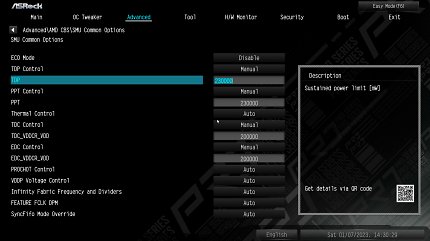 Redundancy pays off: in two places familiar from the X670 and B650, the TDP and PPT options have been deleted from the A620 UEFI, but there is a third.Source: PC Games HardwareAMD Overclocking has also been emptied by the manufacturer – manual CPU Overclocking has been completely eliminated and not even the menu entry remains for Precision Boost Overdrive.But the “AMD…” menus are not only redundant to the mainboard manufacturer’s own areas of the UEFIs, but also to each other: The same package power options can also be found under AMD CBSSMU Common Options and attached the AGESA developers apparently didn’t think so – and Asrock leaves all the options in the UEFI that could help the user anyway, no matter how superfluous they appear at first.So, in addition to a switch for Eco Mode, we also find setting options for TDP, PPT, EDC, TDC & Co.
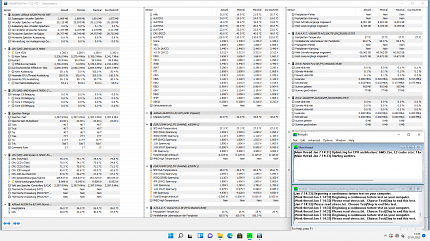 Too bad: an increased package power tracking for the CPU does not override the 165 W limit of our A620 test board.However, PPT reductions are implemented.Source: PC Games HardwareIn the practical test, these prove to be a partial success: Unfortunately, increases above the board’s own PPT limit are ignored.In addition to the CPU’s own default values, exceeding which would be prohibited tuning, and the user requests that can be stored in AMD CBS, there are obviously the mainboard limits as hard-coded, inaccessible limits.The turbo limit in real operation is then determined by the smallest of these three values.Conversely, this means: PPT reductions to reduce power and cooling requirements are also possible with A620 mainboards.This does not optimize the efficiency as much as with additional V/F curve optimization or undervolting, but no stability reserves have to be tested with simple package power limitations.
Incidentally, we addressed Asrock on the subject and in this context pointed out that the voltage converters of the A620M Pro RS should easily be able to cope with the 200 W real consumption of a Ryzen 9 7950X operated according to the manufacturer’s specifications, at least under good environmental conditions.The manufacturer is now considering allowing users to change the conservative factory limits.A second A620 test sample from Gigabyte has meanwhile arrived at the editorial office, and a third from Asus has been promised – we hope to finally be able to create a complete comparison test for our July issue (PCGH 08/2023, EVT 5.7.) in June, in which We will then also go into detail about the respective setting options.